Journal · November 6, 2026
Mortal Coiled Spectre
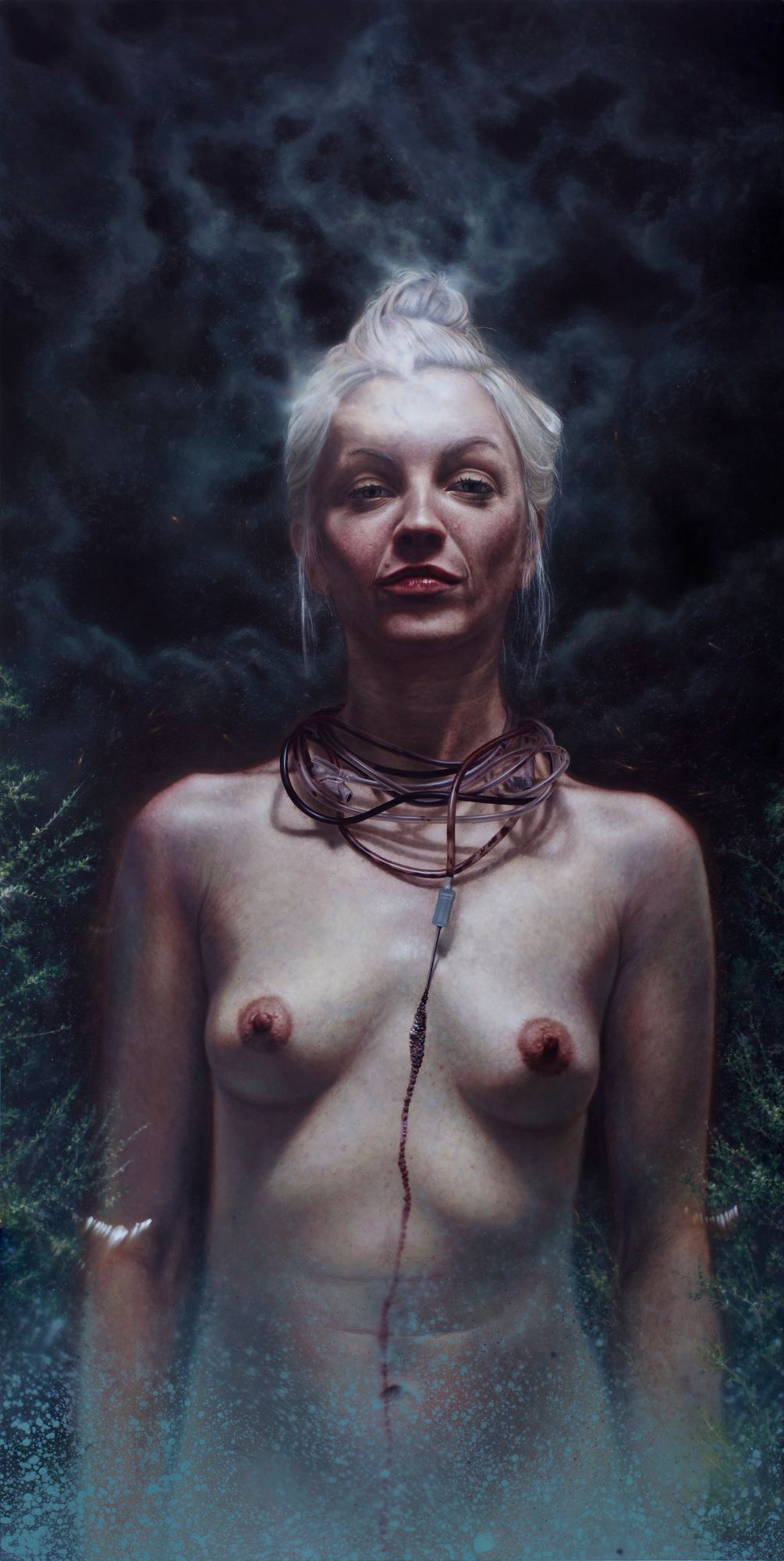
A meditation on the paradox of mourning the living, Mortal Coiled Spectre depicts the psychological afterlife of a person whose physical existence continues beyond the death of intimacy and relationship. What remains is a contradiction of presence and loss, and cognitive dissonance over the grief of losing a person who is still alive. A physical presence still exists, elsewhere, while an internal conception of a once-familiar identity fragments and dissolves.
The evolution of the work carries a personal literary parallel to Oscar Wilde’s The Picture of Dorian Gray, a slowly altered portrait of a former muse and partner which gradually accumulated an increasingly unsettling presence in the aftermath of our separation. As if life truly could imitate that 19th century literary art, the once-familiar expression of the sitter seemingly became a more focused gaze—an uncomfortable reminder of loss and failure in my home studio.
While the portrait in Wilde’s tale becomes a grotesque reflection of its own subject’s hidden deterioration, my painting seemed to assume a life independent of the person it depicted, confronting me with the shadow of a shared past. Its gradual physical transformation over the past year became a cathartic act and an attempt to reconcile the dissonance between the person remembered and the painted version who remained.
The painting’s surface embodies this process of transformation through numerous layers of splattered, abraded, and sanded paint. As with most of my recent work, accumulation and removal become inseparable, as new marks obscure earlier passages while subtractive techniques expose fragments of what lies beneath. The resulting surface demonstrates the visible effects of time, echoing the gradual deterioration of youth and memory. This surface degradation, a physical condition of the painting’s construction, becomes an important layer of symbolism which completes the narrative arc of the work.
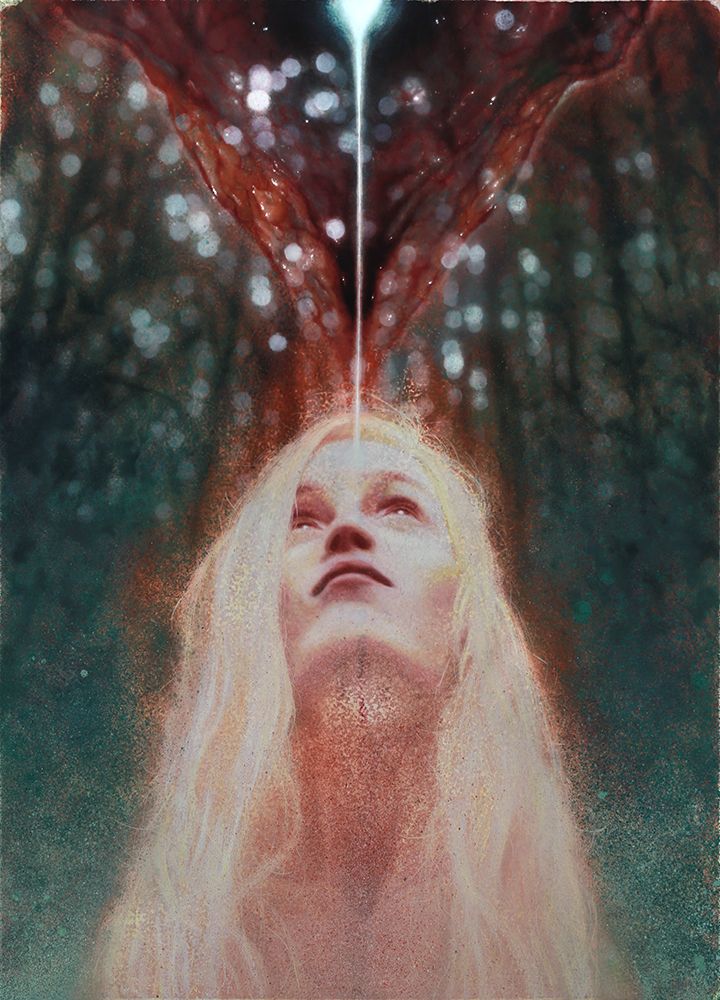
The face is the primary means by which we recognize another person. It is also the surface through which we imagine we can perceive their inner life. The face in the painting now dissolves and splits apart, disrupting the illusion of a coherent, knowable identity. What is revealed underneath is not a hidden, more authentic face, but a wound, both rising to and descending from the cosmos; the tragicomic foundation of our psyche, the soul’s burden, the lesson given to us by the universal source to untangle in this life.
A fragmented, glistening serpent winds across the torso, neck, and face, establishing a continuity between corporeality and consciousness. From the lower body and its association with primal and sexual energies, it ascends into the region of identity, thought, perception, and ultimately the cosmic wound, creating a visual progression from embodied intimacy toward psychological rupture and eventually, ego dissolution.
In referencing both Shakespeare’s Hamlet and the Eastern concept of Kundalini, the coiled serpent represents the condition of being bound to human suffering and, simultaneously, the possibility of awakening, release, and transformation. The same coil is both bondage and liberation.
The energy is healing just as it is destructive. Kundalini awakening is conventionally associated with spiritual transformation, but the painting’s arrangement complicates that symbolism: the ascending force is accompanied by the fragmentation of identity and the exposure of a wound, creating tension through ambiguity. It may be a consequence or an origin, an opening or a tether, or, finally, is the wound itself the site of transformation? The imagery accommodates all three possibilities without resolving them.
The dark, shadowy machinery surrounding the fractured head references the philosophical concept of the ghost in the machine and Arthur Koestler’s theory of holons, which I came to understand through the work of Ken Wilber. Holons are entities that exist simultaneously as autonomous wholes and as interdependent parts concentrically nested within larger systems. The machinery suggests the structures of the psyche through which we construct both our sense of self and our understanding of others. Instinctive rigidity that helps us feel secure even as it entraps us within painful cycles.
A relationship ends. The connected machinery and shared psychological structure of two individuals ceases to function as a coherent whole, yet its constituent memories and attachments persist. The figure who exists within memory becomes increasingly independent of the person who continues living somewhere in the world—a ghost sustained by the machinery of consciousness that cannot fully relinquish it.
The serpent winds through and across the human form while this machinery surrounds the region of consciousness. At their intersection is the rupture, the wound, the threshold between systems of existence. The biological body remains. The psychological identity fragments. The spiritual energy ascends. The ghost is what emerges, trapped in the machinery of memory, when these systems no longer form a coherent whole.
But the spectre is not merely a ghost associated with the mortal coil. It is a ghost that has been wound, bound, entangled like the medical tubes full of liquid life—a haunting from which neither the subject nor the observer has been released.
The words I chose for the painting’s title may seem to describe incompatible states of being, but the image gives each of them a literal visual counterpart. This makes the title more than a poetic juxtaposition—it becomes a compressed description of the painting's central paradox, a liminal state between life and death where grief is processed through the ghosts of memory.
Nick Baxter November 2026
Discussion
No comments yet.
Loading…