Journal
Practice & process notes
Occasional writing on my art practice, techniques, process, and the ideas behind the work.
4 articles on still life
June 16, 2025
What Dreams Wither
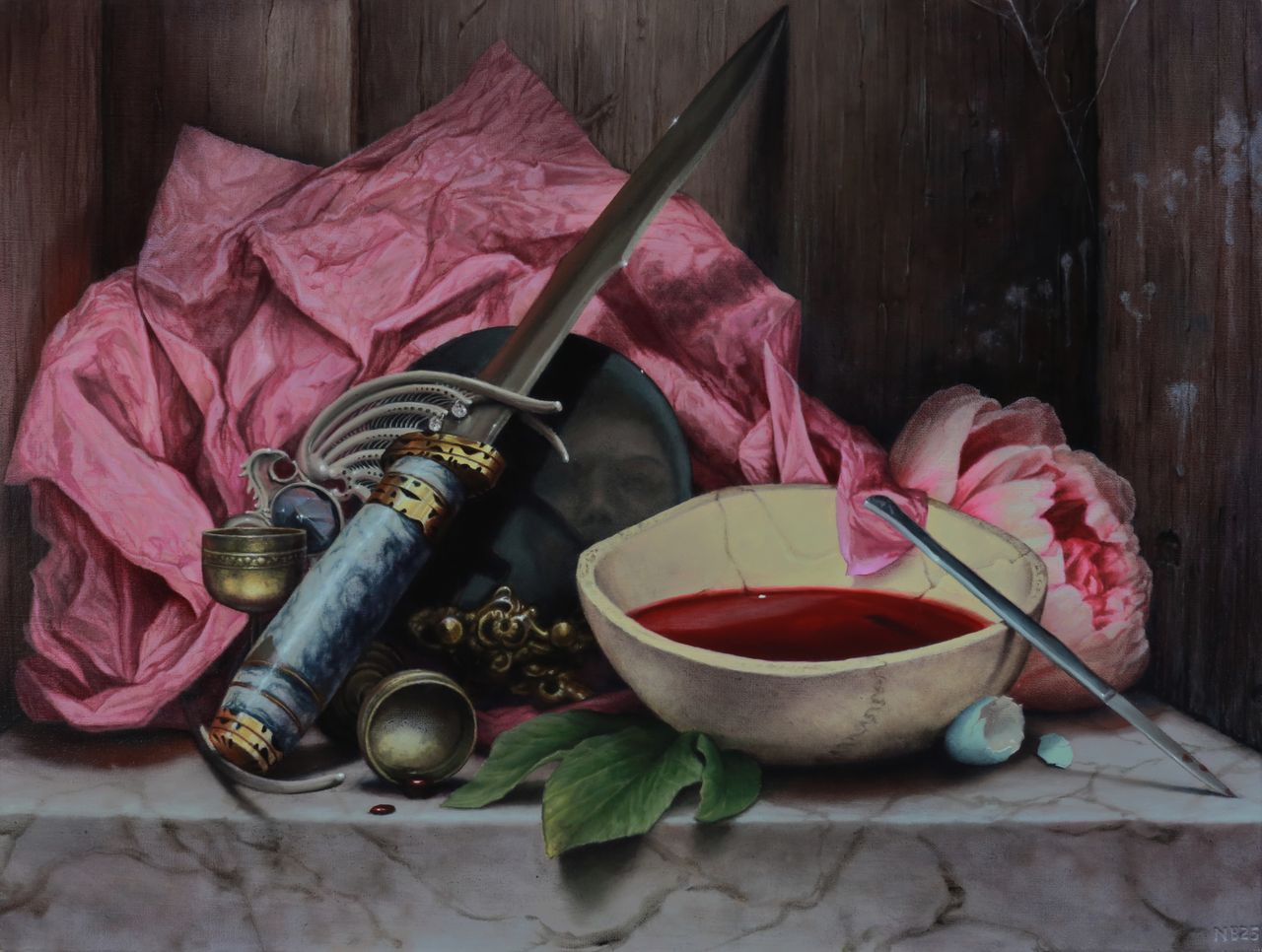
Fresh off the easel today is this new still life, my first classical still life in years, actually--a commission for a dedicated collector of my artwork featuring items of personal significance to her. "What Dreams Wither" oil on linen panel, 12 x 16 inches, 2025 (private collection) It was great fun revisiting these techniques and some dark vanitas subject matter, which was utilized heavily in my "Blood Rituals" series from 2016-20. I consider this painting to be the newest--albeit posthumous--addition to that series. The prominent use of the color pink in this piece is symbolic of innocence, naivete, and femininity, the crumpled tissue paper evoking fragility and gifts unpacked, wrappings tossed aside. The softness of the peony and the sparkling tiara complete the feminine symbolism, which is contrasted by the masculine hardness of the dagger, knife, and marble slab upon which the scene has played out. As with other pieces in the Blood Rituals series my focus is on the aftermath of events; quiet overlooked moments and the ephemera of some unknown human activity. These objects left behind and cluttered in a corner of a cabinet or hutch have a new importance as artifacts, telling the story of innocence lost, illusions pierced by hard truths, wisdom hard-earned through suffering, childhood dreams withered in the cold autumn of adulthood. A subtle nod to Jung and the psychological archetypes is given in the upturned cranial cap, the blood the life force and animator of the self. We spill it and drink it in, and someday it will be all gone. The vanitas still life reminds us of this fleeting cycle, urging us not to lose ourselves in the decay of material pleasures and the flesh, and instead seek the ultimate truth of personal enlightenment.
Read →

April 24, 2016
2016 Peto Biennial
I’m very honored and excited to have been among the artists whose work was selected for the John F. Peto Studio Museum’s 2016 Biennial. This marks my second time being included in the show, which is a juried exhibition with cash awards at stake. The piece selected this time around was my recent still life “To The Nadir,” which is first in a series of new work tentatively titled “Blood Rituals.” To The Nadir, oil on linen panel, 11 x 14 inches, 2016 I’ll be debuting this new body of work (which I feel is some of my best yet!) later this year. More details to follow on that exhibition, and hopefully some writing about the themes and symbolism of the series, so stay tuned! For now, if you’re in the New Jersey area and into classical still life painting, don’t miss what will surely be an amazing show full of mesmerizing technical mastery.
Read →
February 2, 2013
New Vessels
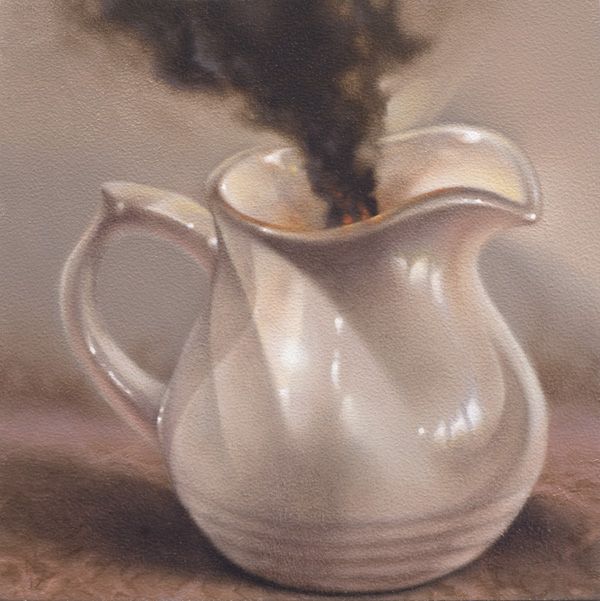
Lately I’ve been brainstorming and refining a new artistic vision, taking the opportunity of any downtime between large surgery paintings to complete some smaller, fast-paced still lifes with a much different palette and ambiance. These pieces utilize clean forms and simple compositions, attempting a confluence of opposites to symbolize the precarity of industrial civilization in the new millennium, the increasing sense of dread among many who see the global destructiveness and the coming end of late-stage capitalism: Serenity and catastrophe…the mundane and the dramatic…solidity and ethereality. Like much of my work these pieces are also influenced by Buddhist philosophy, with smooth surfaces representing the perfection of form that simultaneously experiences impermanence: smoke, flames, and ultimately, annihilation. These vessels are bodies facing their inevitable destruction through aging, inflammation and disease. These vessels are the purification of the ego, burning away its own delusion and illusion. Endgame II, oil on panel, 6 x 7in, 2012 Endgame III, oil on board, 6.5 x 7.5in, 2012-13 This budding series is an expansion and evolution of the themes broached in another less recent painting, which of course is also a metaphor for the edifices of civilization and their approaching collapse; the rise and fall of human achievement: Endgame I, oil on canvas, 5 x 7in, 2009-12 My plan (completely subject to change in the winds of artistic inspiration or be ground in the gears of other life obligations) is to continue to refine these concepts and build up to scenes of larger scale and higher complexity, as I wind down my Apostasy series this year. Who knows what will actually happen, but I’m excited and nervous about finding new challenges. So stay tuned for more updates on both endeavors. Small, medium, and large…
Read →
December 21, 2012
Notes & Advice 4: Clear Seeing and Accurate Drawing
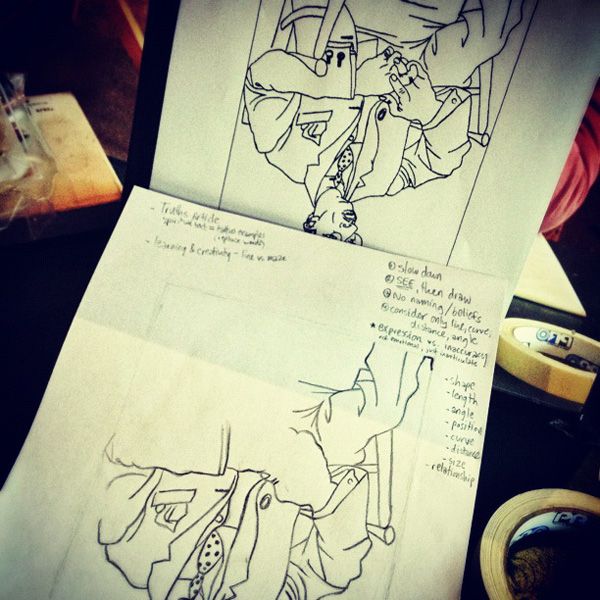
Earlier this month I attended a 3 day intensive drawing course hosted by an artistic mentor of mine, Edward Povey. This course started from the absolute foundations of drawing–clear and simple seeing, lines, and shapes–and progressed by the third day, after a brief foray into tone and value, into a full-fledged classical still life. While I had taken a similar foundations of drawing course around a decade ago (wow, that sounds like I’m old…and an “adult.” Wierd.) in art college, I wanted to revisit these incredibly important disciplines in order to sharpen up my artistic skills. Edward taught the course with a combination of classic drawing exercises, and insightful personal anecdotes about the nature of seeing. His philosophy emphasized the faithful recording what we see, in the tradition of “the humble craftsman.” Exercise: reproduce the Picasso drawing upside down, without regard to subject matter. Simply observe line, shapes, and proportions. Many of the exercises were taken directly from the popular book by Betty Edwards Drawing On the Right Side of The Brain ( which I personally have never read, but can now vouch for after this experience), such as the Vase/Face exercise which you can see here. One of the most demonstrative exercises consisted of trying to reproduce a complex line shape in exact precision while simultaneously counting aloud, from 50 to zero. I won’t spoil the amusing results of conducting such an experiment by describing them in detail here, in case you should decide to try it yourself. But let’s just say, it puts the two sides of your brain into a major state of conflict. All drawing consists of, is working with one’s own mind. The most poignant lesson that was reinforced for me over the 3 days was the emphasis on clear, simple seeing. Much like a meditation practice, this places emphasis on simply seeing the physical reality before us in all of its detailed truthfulness, without the confusion nor illusion of belief. For example, our mind knows and believes that a human arm may be approximately 3 feet long, but when seen in sharp perspective, the appearance of the arm becomes far shorter (aka ‘foreshortened’), and we must account for this when drawing it on a 2-dimensional surface. This cognitive dissonance between our belief about the arm and the reality of how it appears on our retinas (and therefore must appear on the paper) is the reason why drawing complex forms with complete accuracy is incredibly difficult. Therefore an artist must learn to disconnect from certain areas of thought in their brain, and tune into the unembellished truth of reality, breaking it down into simple criteria of line, shape, and negative space (the areas or shapes between/around featured subject matter). Extreme precision in this task can be achieved with measuring techniques and devices, but it is not impossible to do so completely with one’s own eyes and mind. It takes patience, practice, and a willingness to let go of our ego and all of its beliefs. Words of wisdom. As a painter of realism, this practice is indispensable for me. All of my aesthetic illusions must be grounded in, must stem from, the fundamental truth of how objects or spaces look in reality, or else their believability will be compromised. Not to mention, the strength of all representational art in the first place, regardless of chosen specialty or chosen illusions, lies in the accurate reproduction of 3D forms onto a 2D surface. Subjecting oneself to the rigors of classical drawing training is the most efficient way to stay sharp, no matter how advanced or practiced one is. It’s the same concept as strengthening muscles by going to the gym. After a while, certain drawing exercises are likely to make less of an impact as they become more familiar/easier, and just as with physical strength, the artist can increase the artistic challenge by adding time limits or more complex subject matter. I strongly encourage all artists to revisit the simple disciplines of drawing as a way to “work out” their skills of observation and their representational accuracy. Here’s my completed drawing from the final day of the class: Form & Emptiness, Graphite on Paper, 2012, 12in x 9in Form & Emptiness (detail). The title of this piece is a reference to the Buddhist teachings on the nature of reality, as represented by the dominating dark form in the center of the composition bearing my reflection, and of course by the empty glass and mug. This title is also a reference to the similarities between the clear seeing techniques used for drawing, and the awareness cultivated in meditation practice.
Read →