Journal
Practice & process notes
Occasional writing on my art practice, techniques, process, and the ideas behind the work.
4 articles on plein air painting
July 27, 2026
The Alchemy Of Self: Plein Air Painting In The Mountains Of Colorado
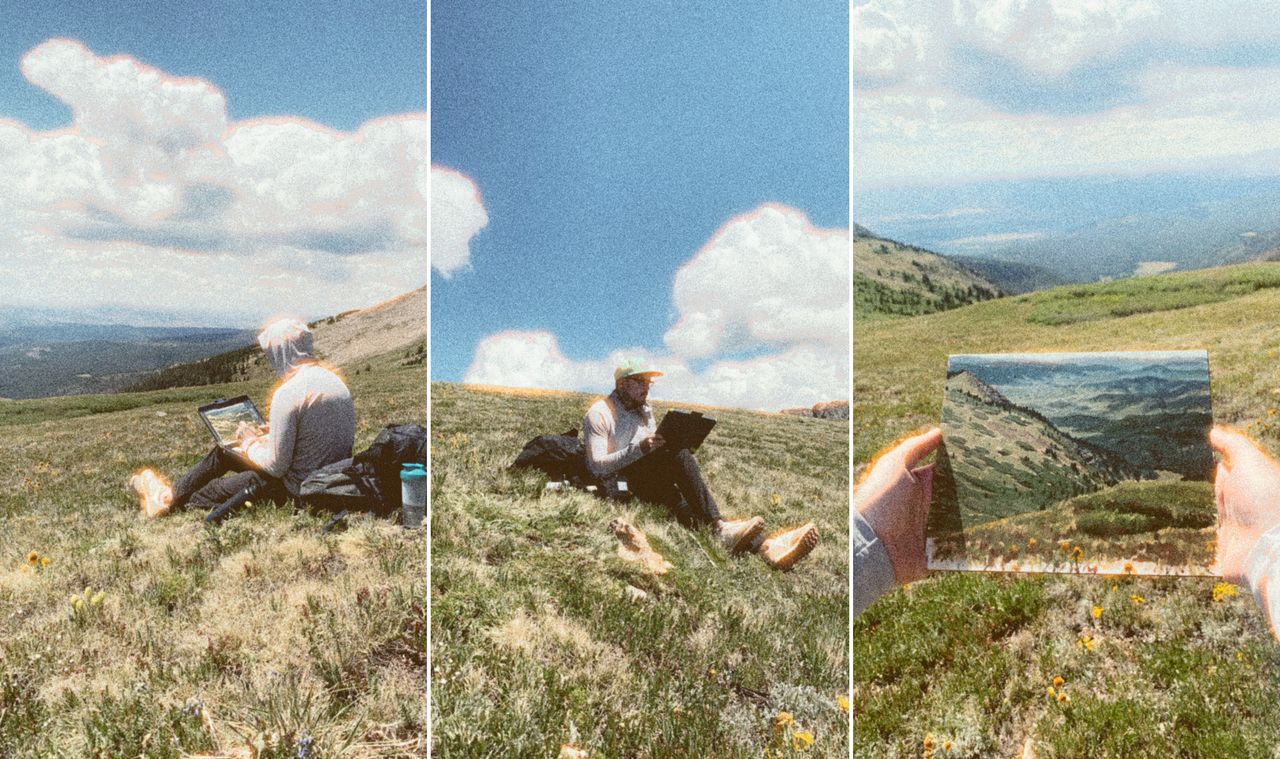
Recently I met up with an old friend in Granby, Colorado and hiked The Devil’s Thumb trail, a 7.5 mile out and back with a 2247 foot climb over rough terrain, at a starting altitude of around 9000 feet. I thought the day would be a fun proof of concept for my DIY plein air painting rig, to prove to myself that it’s a viable setup for a strenuous and difficult hike. What it turned into was the most difficult hike I’ve ever done and a proof of concept for so much more. The altitude, the heat, the weight of the gear, and the sheer elevation gain soon became major factors and about 2/3 up the ascent, in a wildfire scorched swath of dead timber and stifling heat, I was wobbly with fatigue and mentally battling through every second, focusing my entire attention on each movement of my legs, reaching deep for all the meditation techniques I’ve practiced over the years. I had many moments of doubt, some moments of frustration, a few of panic, and eventually a breakthrough of surrender to the goal. My mind became laser focused on a single point: I will not disappoint my friend or myself, I will reach the top and make the painting I planned on. All of reality, all possibilities in the entire universe shrunk down to this one specific, inevitable, unquestionable outcome. This is a conscious nonduality I’ve chased for many years making art—a flow state of pure freedom where the self is lost to the goal, and the art makes itself through the conduit of me. A willing surrender. Having this realization that surrendering my self and all its pointless fears and doubts was actually the only way I was going to reach the summit, was when I felt in stunning realtime clarity the past few years of struggle, depression, grief, and rage become compressed and dissolved by a single breath and step at a time. The future is a fantasy, the past is a memory; only this moment is real. And now this moment. This breath. This foot stepping forward. Now this one. Place foot on rock. Engage glutes, push. Breathe in, drag it deep into diaphragm, exhale slowly. Do it again. Complete this moment, survive to the next moment. After many moments the summit was reached. I laid down in the grass, with a pounding migraine and nausea, and achieved my goal of making a painting. I was too tired to stand and never used my tripod, suddenly useless weight that I had unnecessarily trudged up the mountain. No worries, my rig is still a success, viable in extreme difficulty day hikes. And most importantly, suffering was alchemized into achievement and the limitations of ego and self were transcended. The universe works as designed too. View From Devil's Thumb, oil on panel, 8 x 10 inches, 2026
Read →
November 8, 2023
Then, And Now (Part 5)
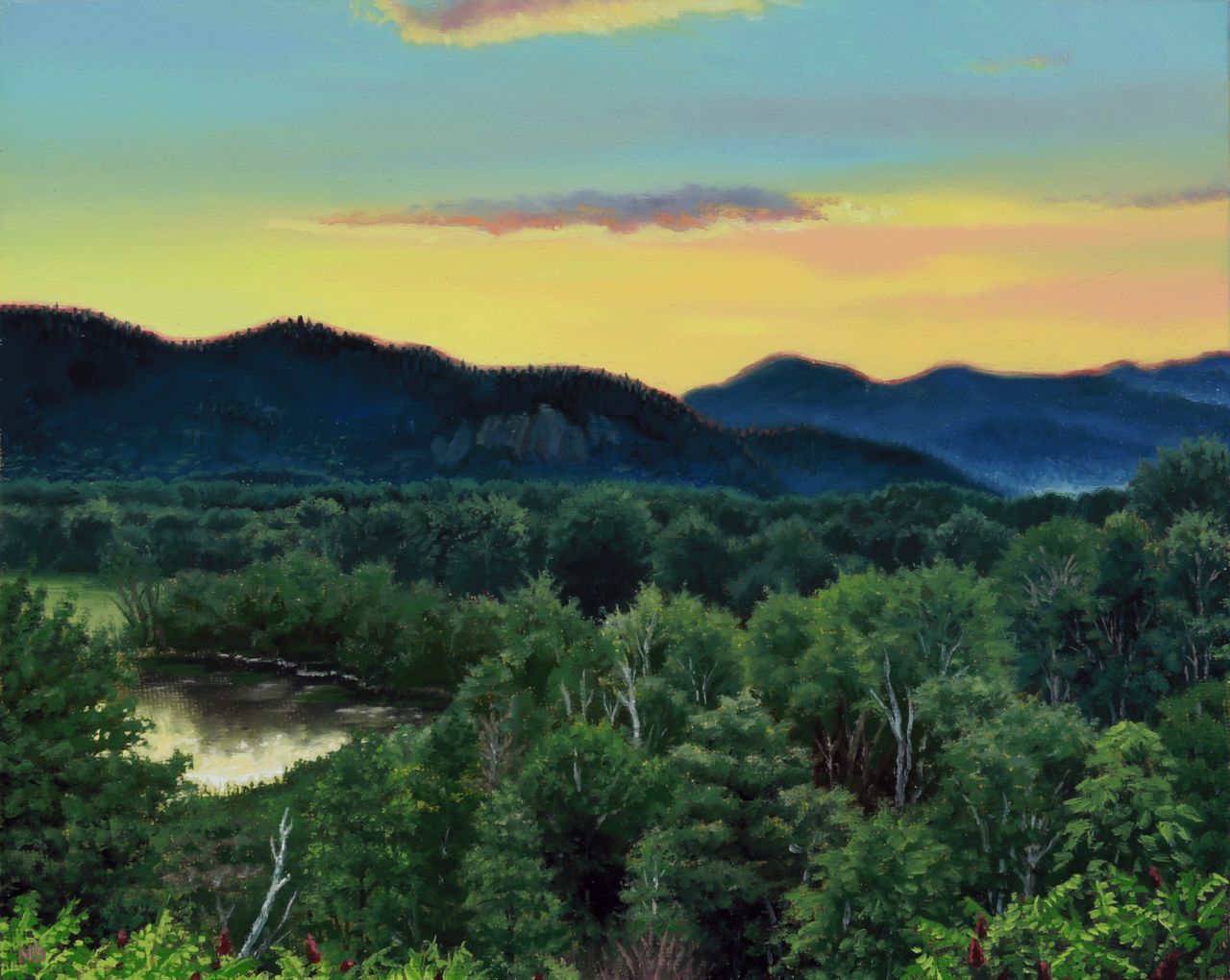
"Then, And Now" or "Then & Now" in the blog search feature, is an ongoing occasional series where themes of progression, time, and memory are explored. "White Mountains Sunset" / Oil on Canvas Panel / 8 x 10 inches / 2023 This painting has an interesting backstory, starting in 2015 when I took an amazing plein air landscape painting workshop in New Hampshire from Thomas Kegler, offered through the Grand Central Atelier. I was brand new to the genre of landscape after having done still life painting for years, and on this evening a sunset painting meetup with renowned landscape painter Erik Koeppel and others was scheduled, which would be my first time ever attempting the extreme challenge of capturing a live sunset in paint. I was thrilled to be painting alongside these legends of the genre and did my best to soak up any knowledge I could while absolutely speed-panic painting my way through a much too short sunset. It was a memorable experience for me and the artistic result was far less important than the practice and mental impressions made. "White Mountains Sunset" / Oil on Canvas Panel / 8 x 10 inches / 2015 As such, I was never happy with the results of my painting and it sat on my studio drying rack since that trip, offering a great memory and calling out faintly to be resolved into a product I can be more happy with. As fate would have it, and I won’t attempt to even speculate why, these past few months was when the random spark of an idea and inspiration finally came to me after 8 years, and I knew it was time to rework this thing. I focused on accuracy this time around, as it had been so long that I was resigned to using photo references from that evening rather than relying on memory, and I always hated how inaccurate the mountains turned out the first time. The rest of the original study was encouragingly accurate to the hazy color diffusion of those moments and the rest of the spatial proportions. I regret losing that hazy pastel color chord in my reworking, which ended up being based on a later stage of the sunset when the forest and mountains had become much darker and cooler, no longer bathed in amber glow. But despite changing its palette and color harmony, I believe it to be a better painting now overall, and feel a sense of closure that this at least won’t be haunting me from the studio wall anymore. Side note: improvement is guaranteed if you just show up and put in the time and effort consistently! So if you’ve been grinding, don’t be afraid to revisit old work when the time finally feels right. Finishing paintings, no matter how long after the fact, allows an artist to learn more lessons and ultimately improve more than abandoning unfinished projects for good.
Read →
September 9, 2023
Summer Plein Air: Chasing The Light
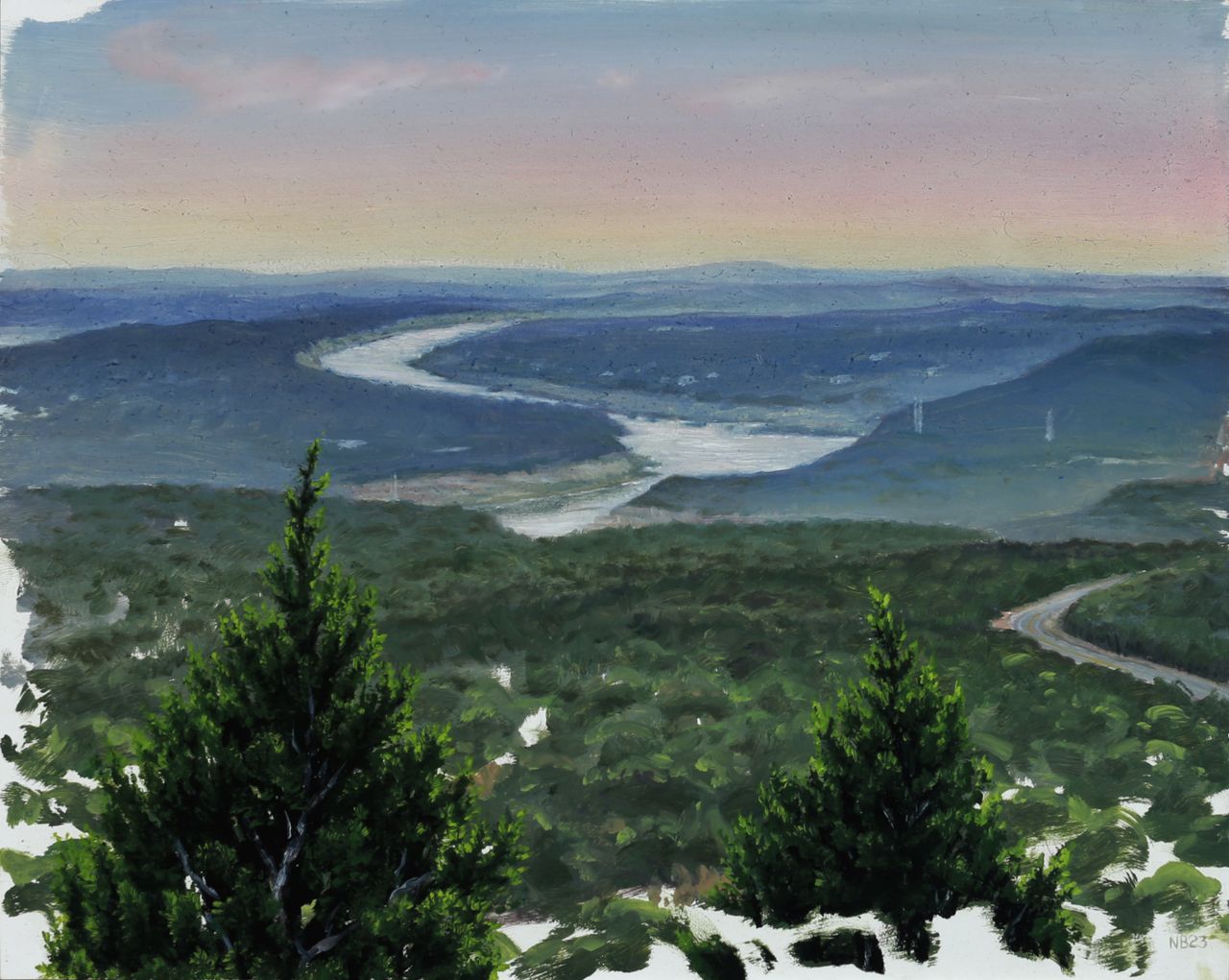
Summer in Texas, where I live and work, is never the best outdoor painting time. Extreme heat and incredibly harsh, searing daylight add degrees of difficulty to the plein air process, to speak nothing of the extra extreme summer of heat we've been having this year. But I did manage to get outdoors and paint a few times lately–thanks to some great friends providing an extra bit of motivation–for a much needed dose of artistic nature time. First was a quick sunset sprint at a local overlook, on a very hot and hazy evening. The air was so thick that the scene looked foggy, and this moisture in the air diffused the dusk light nicely into a wash of pastel hues. I blocked in the basics of the distant river bend for an hour on my 8 x 10 inch panel before the sun disappeared on us, disregarding the slower detailed areas of juniper trees in the extreme foreground. After letting the painting dry for a few days, these were then rendered in a 2 hour studio session along with some pastel glazes in the sky to saturate the sunset effect. "Dusk Over Lago Vista", oil on panel, 8 x 10 inches, 2023 During our next outing, shade was a requirement as it was late morning and the sun was already in full blast, warming up to another triple digit temperature day. We chose a lowland trail snaking alongside a dry creek bed under cover of thick live oak, juniper, hackberry, and pecan trees. Hoping for a small waterfall that feeds into the creek, we soon realized that with our region's severe drought status that was a pipedream, and settled for a little shaded clearing opening up to the dry creek bed next to the trail. The summer death rays of the sun puncturing the canopy created a perfect opportunity for some fun lighting effects–quite the opposite of the previous outing's diffused hazy ones. We painted for approximately 3 hours, in which time I got a thorough block-in of the detailed scene accomplished on another 8 x 10 inch panel, knowing that once again I would spend another 2 hours in the studio after it had dried, completing the effects of light and shadow, warm and cool, with a glaze layer. This level of realist subtlety in atmospheric affects simply is not possible with the alla prima technique of single-session plein air painting, as the optical combination of translucent color sitting on top of opaque color is what creates the more convincing illusion of depth that our eye perceives in a painting. "Dry Creek Bed, River Place", oil on canvas panel, 8 x 10 inches, 2023 When I’m scouting a painting location I’m always looking for a focal point, a primary feature of the environment or lighting that will interest a viewer more than a mere factual recording of a place and time. There are always time constraints imposed on an outdoor painting and sometimes you settle for a mundane scene (without a waterfall...) that needs to be made more interesting by focusing on what the light is doing, emphasizing color or atmosphere beyond what is observed but still within the bounds of convincing realism. That’s what happened here. The serpentine tree shapes were interesting but beyond that, the white hot dappled light on shaded rocks was going to be the real star of the show, with a little coaxing. P.S.– Here's a bonus miniature 5 x 7 inch wave study from a trip to Miami Beach earlier in the summer, completed in the same 2-session manner as the aforementioned pieces. Oil on Panel, 5 x 7 inches, 2023
Read →
October 4, 2019
On The Mechanics of Seeing
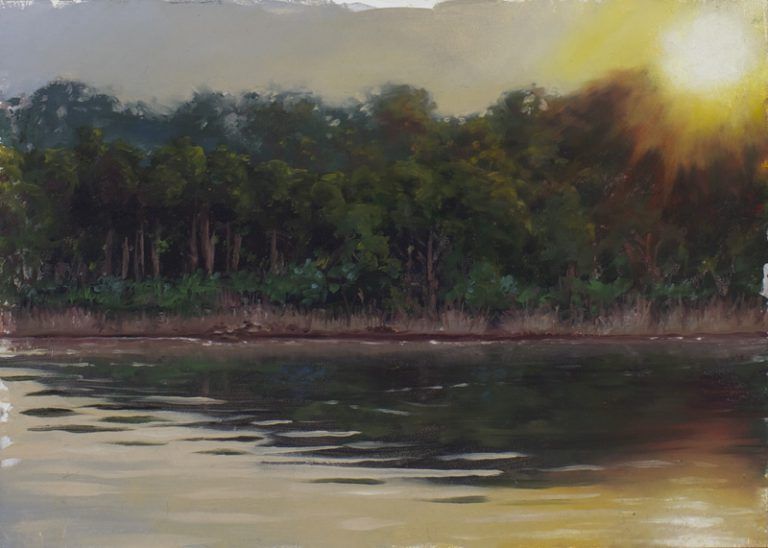
A long time ago on this blog I touched upon the brain’s instinctive practice of limiting the amount of visual information we tend to perceive. The point of writing about this was that it applies directly to the practice of painting from life, and really, to all methods and genres of painting. But in particular, representational realism, because obviously this genre is so closely tied to the science of seeing. As opposed to passively looking, actively seeing something means thinking about it as we look, with intention, to analyze and deconstruct what is happening with light, shadow, value, color, form, dimension and so on. The more intimately we understand all those criteria as artists, the better equipped we’ll be to recreate on canvas what we’re seeing in real life (or our reference material), both in terms of accuracy and emotional expression–that unquantifiable sense of awe and magic that occurs when viewing the best or most powerful art. The paintings that have both–an uncanny sense of believably as well as a profound sense of feeling–are in my opinion the very best, and are of course what I strive towards whenever I pick up a brush. I feel that in order to even begin to have a chance at achieving one or both of those goals, an artist needs to understand what the eye-brain feedback loop is doing, and why. “Greer’s Ferry Lake Sunset”, 5×7 inches, Oil on Panel, 2018 (painted en plein air) In short, our brain instinctively wants to find the shortest distance between two points. Without us telling it to, it sifts through all the billions of points of visual data our eyes take in, then selects the most important of that data to help us navigate the environment and make choices on how to act. I’ve found this phenomenon to be most apparent, and challenging, in the genre of landscape painting. When gazing out over a forest of trees, each with millions of leaves and hundreds of branches, all bathed in a haze of atmosphere, that view usually gets condensed into a clumpy horizontal band of olive-y green so that our brain can free up computing power for anything else that may be of more pressing concern. Overriding this instinct takes intention and a conscious choice in the moment. In doing so we can then bring our awareness slowly to each and every minuscule aspect of the scene in order to pick and choose what we will emphasize, subordinate, or omit entirely. Being an artist takes this one challenging step further. From there, we have to discern when, where, and how best to simplify the overwhelming amount of detail we see in order to create the illusion of what we were looking at for the viewer of our painting, which allows their own brains to fill in the omitted details on its own. And we have to do this all the while adhering to artistic principles that make good art, like color harmony, composition, value structure, symbolism, hierarchy of focus, among others. Err too far to the accurate detail side, and you can end up with a technically proficient but soulless, boring rendition. Err too far to the interpretive extreme and you can end up with a distorted, unintelligible or non-convincing pile of whimsy (in other words, abstract expressionism?). Hitting the sweet spot for our goals as representational realist painters is the ultimate challenge, daunting and addicting all at once. If you want to learn more about the phenomenon of seeing from a more scientific angle, read this great article I found today. Some nice parallels can be drawn from it to what we are doing as artists. https://www.quantamagazine.org/your-brain-chooses-what-to-let-you-see-20190930/
Read →