Journal
Practice & process notes
Occasional writing on my art practice, techniques, process, and the ideas behind the work.
4 articles on landscape
November 1, 2019
On The Benefits of Drawing
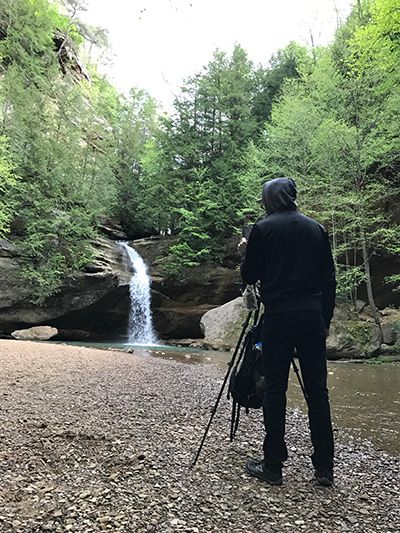
About 10 years ago I leveled up my artistic practice in all areas after discovering the classical atelier system of art education. Before that time I had been piecing together my own slow, winding learning trajectory in the realism painting genre, unintentionally slowing my progression with an over-reliance on photographic reference. In contrast, the atelier system is based on working directly from life, whether it be a live model, a still life, or a landscape. Painting from life in Ohio, 2017 In short, observing directly with one’s own eyes forces the brain and the artist’s hand to convert the 3 dimensions of real life into the 2 dimensions of a flat canvas. Over time our eyes-brain-hand feedback loop becomes seamless, and we learn how to reproduce exactly what we see. The real-time, real life mental calculations of angles, lines, curves, planes, perspective, light and shadow, and millions of color possibilities have a measurable result: if the drawing or painting looks indistinguishable from what we’re observing, then those myriad calculations are overwhelmingly correct. Of course, eventually, an artist needs to learn how, when, and where to diverge from absolute accuracy in order to create a work of art that transcends the mere replication of reality…but the learning process that we submit to in order to reach that point is surprisingly valuable in its own right. “Lower Falls at Old Man’s Cave”, 8x 10 inches, oil on panel, 2017 Arguably the single most important artistic discipline or skill, simple life drawing is actually a fairly complex amalgam of skills, requiring at least a rudimentary working knowledge of geometry, physics, optics, and the ability to plan sequentially. True life drawing begins as little more than primitive map making–the plotting of coordinates in space–and ends ideally with an incredibly nuanced understanding of the physics of form, mass, and light. This great article I stumbled across got me thinking about drawing; what it forces our brains to do, and how it benefits our brains. While intended for the non-artist reader, it makes great cross-disciplinary connections and serves as a nice reminder and motivator for anyone who is an actual practicing artist, of just how valuable drawing is to our art. https://qz.com/quartzy/1381916/drawing-is-the-best-way-to-learn-even-if-youre-no-leonardo-da-vinci/ “Form & Emptiness”, graphite on paper, 2012 Form & Emptiness (detail), graphite on paper, 2012
Read →
January 27, 2017
In The Studio 5: Reworking Plein Air Landscapes
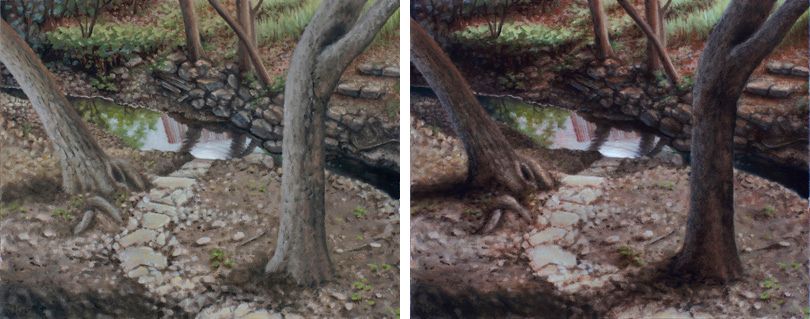
Something I’ve never been a fan of doing is revisiting older paintings after some time has passed. The process of reconstructing or even merely re-approaching the original mindstate, inspiration, and vision for the painting feels spiritually regurgitative in some unclean way. Like digging up a dead issue in a relationship with your partner. I’ve never been one to want to dwell in the past, favoring the pursuit of new goals and the exploration of new territory over the retread of old ground. But since embarking on a landscape painting journey over the past few years I’ve seen some of the masters of the genre doing just this–picking up old plein air studies to breath new life into them, perhaps making them more presentable as a truly finished piece to a buying audience–and had stared at some of my early plein air studies long enough to realize how I too could push the sense of drama or atmosphere in them. View From The Studio, before (L) and after glaze layer. Not to mention, more hours logged in the practice of landscape painting, more hours logged studying weather and outdoor light with more intention and discernment, has had the natural and inevitable effect of expanding my critique ability of what I’ve previously done as well as eased some of my fears about ruining those original results. This shift is the tangible, or at least quantitative, proof that learning is happening–awesome! So in a brief fit of discontented boredom lately I pulled a few early landscapes off the wall and put my glazing knowledge learned from many hours of studio still life painting to use on some formerly alla-prima studies that looked a little flat. Oil glazing truly does replicate the phenomenon of translucent–but not completely transparent–atmosphere that we live in and see through every time we gaze into the distance. Which makes it a perfect tool in the landscape painter’s skillset. For advanced stages of realism in any genre I find it to be absolutely indispensable, and enjoyed the practice of applying it to my new pursuit of landscape painting mastery. A little 4 x 6 inch study of my former backyard bridge, given a more dramatic late afternoon shadow treatment.
Read →
January 2, 2016
Miniature Landscapes
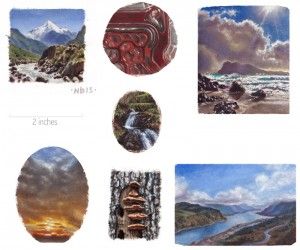
This past month I unearthed a bunch of tiny frames from my studio storage for the purpose of painting little gifts for friends and family this holiday season. I’d been collecting these things at various vintage stores and yard sales for the past several years for just such an occasion. Looking to tap into the peace and simplicity of painting outdoors during this colder (mostly) indoors season, I decided to attempt some miniature landscapes for these frames. Various miniatures, oil on canvas paper, 2015 For the first time since embarking on my landscape painting journey about a year ago, I worked from photos rather than “en plein air.” Although unable to immerse myself in the atmosphere and unique light properties of the setting, I found the photos an incredibly effective practice modality due to the minimum of mental conversion needed in the controlled studio environment. The unchanging two-dimensional photo and the optimal lighting conditions were a great way to narrow down the variables in the artistic equation, freeing up my memory to attempt to rekindle some of the original vibe of these landscape locations, as well as focus on fundamentals like color matching and painting technique. I imagine this being somewhat similar to what the Hudson River School masters experienced in their studios, working strictly from memory and their plein air field studies. Miraflores Beach at Night, oil on linen panel, 4 x 6 inches, 2015 Full Moon Sunset Over East Austin, oil on linen panel, 4 x 6 inches (oval), 2015 Each of these tiny paintings were completed with the alla-prima technique over the course of a single 2-3 hour session, including the lone non-landscape study of the inside of an apheresis blood cassette (random, I know…more on this in the coming months, hopefully…), which was a gift for my phlebotomist friend.
Read →
September 1, 2015
Summer Plein Air Adventures
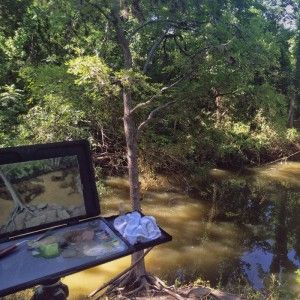
This summer marked my first serious foray into true outdoor ( plein air ) landscape painting, in an effort to deepen my knowledge on the visual effects of atmosphere and natural light. This endeavor also conveniently bridged a longstanding divide between my love for exploring the outdoors and my love of painting. Until this year the two had been almost always mutually exclusive, routinely prompting an internal conflict on beautiful days over whether to satisfy the urge to paint in the studio or the urge to go outside. But I finally confronted my fear of alla prima painting and began the difficult process of learning this completely contradictory painting technique to the one I’ve trained in for over a decade. Although discouraging at times, I couldn’t be happier with my experience so far; it feels like a whole new artistic world has opened up to me…the proverbial kid in the candy store phenomenon. I feel reinvigorated creatively, which any artist knows is a joyous feeling, and I’m excited to see how this new painting discipline evolves my artistic vision. For now I’m still entrenched in the learning curve, looking forward to each new (and challenging) outing, where I’m slowly gaining the experience needed to bring this vast new body of knowledge back into the studio for larger and more ambitous works in my usual indirect layering technique (ala the Hudson River School methods). So here are my favorite plein air studies from this summer, a few of them completed at an incredibly fun workshop taught by Thomas Kegler in the White Mountains of New Hampshire. All are oil on panel and sized either 8 x 10 or 9 x 12 inches. “Purple Trail”, Sleeping Giant State Park, CT “Muddy Creek”, Lockhart State Park, TX “White Mountains Sunset”, North Conway, NH “Cathedral Ledge After A Storm”, North Conway, NH “Bridge To The Studio”, Lockhart, TX “Hill Country Sunset From Mt. Bonnell”, Austin, TX
Read →