Journal
Practice & process notes
Occasional writing on my art practice, techniques, process, and the ideas behind the work.
13 articles on Notes and advice

October 19, 2023
Notes & Advice 12: Tapping Into The Creative Flow
Last week at an educational event for tattooers called the Paradise Tattoo Gathering, I spoke about the flow of creative energy, which is something that all creators and visual artists quite obviously need and depend on. I believe it's a universal force that we can tap into by opening up our awareness and observational skills through artistic training. The act of focusing our minds on practicing a task like life drawing or painting–a task that requires us to continually drop our preconceived notions of reality (ego) and observe with unbiased intensity and clarity–is what opens up the energetic channel within us that receives this universal force. Researchers have called this a "flow state." And for tattooers, drawing/painting/working in other mediums is an incredible way to not only strengthen that artistic flow state but make it easier to access whenever you need it. Excellent, creative, innovative artwork or tattoos don’t happen in a vacuum. This creative energy needs to be allowed into our life/mind by how we're living and being, and then filtered down into our painting or tattooing practice, or whatever artistic medium is at hand. For example, it's very difficult to declare, "I'm going to be creative and come up with a brilliant image or idea, right here and now!" and then just make that happen on command. What is far more realistic or more often the case is that we lose ourselves in the training, in the practice, in the task of learning and developing our skills free from heavy expectations, and in this free and loose state of action or doing, ideas start to occur to us. Iterations and variations on a theme or technique evolve naturally, bringing us to an eventual solution to a visual problem and gifting us the creative ideas or innovations. We get to claim credit for them, and rightfully so as the products of our hard work and dedication, but on a more esoteric level, it's the universal flow of energy (life!) doing us a favor behind the scenes with a wink and a nod. The process described here has been the driving force in my life, and the driving force behind my entire tattoo career. It's something I’ve taught in my “Holistic Approach” tattoo seminar for years, and something I remind myself of constantly in my painting practice as well as tattooing. If you're a tattooer or visual artist searching for your unique, authentic voice or battling the ole artist's block, try thinking about this concept and apply it wherever you can, I think you'll be pleased with the results!
Read →
April 5, 2020
Notes & Advice 12: What To Consider When Setting Up A Still Life
Discussing some of the subtler points of still life setup with Jake Meeks of Fireside Tattoo Network and Podcast. Part of my alla prima still life painting workshop for sale on the fireside website in video module format.
Read →
March 3, 2016
Notes & Advice 11
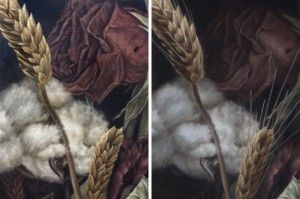
The popular text message shorthand TMI, as most of us growing up in the cell phone era know, means “too much information.” Normally not a good thing–except when it comes to my realism oil painting strategy. To be specific, I find it useful to paint as much information as possible in the beginning stages and opaque layers of my photorealist paintings, so that I can pick and choose where to obscure it during the final (semi-transparent) glazing layers. There’s perhaps a bit of inefficiency involved in this approach, but it allows for a more organic development process overall, and a greater degree of control during the final artistic choices of what to emphasize or subordinate into shadow. “Dying In America” (detail). Before and after the final shadow glazes. Note the subtle loss of detail/information in the rose petals. The human eye is capable of seeing every detail of any given view, but the brain, our computer processor of sorts, is wired for efficiency and baseline survival, and as such is instinctively tuned to only allow us to focus on what is most important in any given view. Details and countless bits and pieces of any scene get stitched together from memory, assumption, and expectation, while a vast majority of the remaining minutiae are simply discarded as inessential to whatever task is at hand. Some of my favorite realism artists were masters of this concept, knowing exactly what to emphasize or subdue in order to pull the viewers attention towards their focus and tug at their heartstrings with an effective narrative or use of symbolism. Notice in John Singer Sargent’s portraits how little attention was paid to large areas of dress, allowing inessential areas to become black or brown silhouettes with no detail. He created a hierarchy of importance within the picture that mimics the way our brains naturally function, using the aforementioned technique to subordinate certain areas. John Singer Sargent. “Madame X (Madame Pierre Gautreau),” 1884, oil. The dress and background, which comprise nearly all of the painting, are almost entirely flat areas of dark valu Andrew Wyath used the technique of reserve just as brilliantly towards the goal of depicting scenic vistas and landscapes with a completely lifelike–yet surprisingly graphic and simplistic–appearance, setting the often somber and peaceful mood with just enough detail to draw us in and keep us looking. Andrew Wyeth. “Sea Boots,” 1976, tempera. Details in the boots and foreground tempered with the geometric simplicity of everything in the top half of the composition. Andrew Wyeth. “Barracoon,” 1976, tempera. Just enough accurate rendering in the figure and folds in the fabric, juxtaposed with large open fields of color and diffused texture. And so I too try to keep the artistic concepts of hierarchy, subordination, and reserve in mind while envisioning my final result, with the goal of creating a visually appealing image, rather than chaotic overload containing a factually truthful amount of information, yet lacking cohesion and harmony. I think these concepts become especially important when painting anything approaching the photorealism genre. Micro details are common and often necessary to complete the desired illusion in this style of painting, and yet conversely, a closed-minded and strict devotion to every detail of one’s photo reference or still life arrangement can result in a less aesthetically pleasing work of art. “Dying In America” (detail). Visual information, as with most things in life, can in fact become too much of a good thing. To make sure I hit my desired sweet spot on the information spectrum, I’m not afraid to paint more detail than will ultimately be needed, only to lose it in deep, rich, believable shadows. The most effective of these shadows will still contain the faintest traces of the details underneath, yet not so much detail as to clutter and distract from my desired focal point. “Dying In America,” 2015, oil on linen panel.
Read →
November 27, 2015
Notes & Advice 10
Written by N.C. Wyeth in a letter to his son Andrew: The great men forever radiate a sharp sense of that profound requirement of an artist, to fully understand that consequences of what he creates are unimportant. Let the motive for action be in the action itself and not in the event. I know from my own experience that when I create with any degree of strength and beauty I have no thought of consequences. Anyone who creates for effect —to score a hit—does not know what he is missing! In other words, paint what you love to paint, what feels true to you, what your passion leads you to create…regardless of how commercially successful it may or may not be, or what current trends or critics endorse as currently fashionable. Let go of worry over results and simply show up to do the work! Important words for any artist questioning their output or their vision (as we all should).
Read →
July 15, 2014
Notes & Advice 9
“If you wish to make certain your painting will succeed, a minimum of three things must come from you–and only you. The first thing is knowing why you want to paint your subject, the second is an analytical grasp of what you see, and the third is the skill to control the process of painting.” – Richard Schmid This quote I recently came across, written by a wise and very accomplished alla prima realism painter, got me thinking about the underlying structure that comprises the task of creating art. Schmid divides this structure nicely into 3 primary, foundational elements. This striking simplicity belies the complexity inherent in most forms of art, especially realism, and that simplicity bodes well for artists and laypersons alike–the so-called “uncreative” types, those who mistakenly regard themselves as “not having an artistic bone in my body.” Here’s my interpretation of Richard Schmid’s quote, expounding on his 3 main tenets and how they (encouragingly) apply to everyone: “Knowing why you want to paint your subject” refers to concept and theory. In other words, the philosophical side of the craft, the ideas and meaning the artist is working with or wishes to communicate through their work (I’ve written a lot about this here and here, with a future post coming as well). This relates to the study of your own mind, to “knowing thyself” and formulating ideas about life and the world around you. I believe that everyone has ideas about themselves and the world around them, because our living brains naturally and instinctively generate thoughts, and we can always translate those thoughts into words and images. “An analytical grasp of what you see” refers to active observation: true “seeing” rather than merely “looking.” Seeing is active analyzation of visual information, whereas looking is passive receiving of visual stimuli. And of course, all but the visually impaired can train their minds and eyes to work in concert, to more deeply understand the structures and lighting of the physical world, in order to convincingly reproduce them on paper or canvas. “The skill to control the process of painting” refers to technique, achieved through practice and repetition, like army boot camp or working out at the gym. Skill and control in painting depend on hand-eye coordination and mastery of materials, i.e. knowing which pigments are transparent or opaque, which mediums to thin your paint with in order to make it do a specific thing, which brushes produce certain effects when combined with specific hand motions, etc. Anyone can train their physical body to remember certain tasks and movements like those involved in painting, even those who don’t consider themselves to be artists. It just depends on one’s level of motivation and available time.
Read →
May 24, 2014
Notes & Advice 8
If you’re into oil painting or realism and somehow not already a fan of Jeremy Geddes, do yourself a favor and check him out. He is a modern master of the fantastic realism genre. When I found an interview about his process and thoughts on realism art, I eagerly read it and found some pearls of wisdom in his humble and deftly concise responses. Although the website this interview was featured on is no longer active, here are some choice excerpts and wise words: Especially helpful to me as a painter were a few choice reminders about the process of completing larger or more ambitious works, including this advice: One mistake I often catch myself in is launching into a full sized painting before I have addressed and resolved all the potential problems in small scale studies. It means I can spend days or weeks in rework for an issue that could have been sorted out in hours if I had followed the correct procedure. Tampering down enthusiasm with pragmatism can be a tricky thing to hold onto sometimes, but it is almost always worth it. And then there’s this insight regarding the public perception of “fine art” and the communicative power, which is a timely reinforcement of some of the conclusions about modern art I described in my “What Is Art?” essay: …the disconnect between the intended meaning of a conceptual work and the meaning that ‘Joe Public’ will take from it is obviously huge, the work is most likely buried in decades of obscure theory that the public has no knowledge of or participation in. I think this quote also brings up the old tree-falling-in-the-woods cliché--if no one heard it, did it even make a sound? And applied to this discussion about art's intended meaning: does it matter, though, if anyone heard it in the first place? Is it not still meaningful, significant, valuable in its own right? My thoughts on visual art as a communication medium are always evolving but lately I'm of the mind that an artist shouldn't "dumb down" their content or symbolism in order to pander to an audience--or an assumption about an audience. But I feel they should have an awareness and acknowledgement that their art's intended communication could fall on deaf ears or be construed in a myriad of unintended ways by whomever...and that's kind of the cool thing about humans, and consciousness, and life...we are, or it is, so vast and so varied and so unpredictable, that when another human sees what you've made and truly gets it, it is a moment to be cherished.
Read →
March 23, 2014
Notes & Advice 7
I came across this great quote the other day from the duo behind The Artist’s Road website and thought to share, since it beautifully summarizes the often overlooked everyday struggle most artists face: to find our purpose for creating and to create something of originality and value to others. To bring a grounded perspective to this existential riddle of sorts, they remind us of the valuable (and also overlooked) societal role of the artist, and finish by describing a helpful personal practice I’ve been using for years. “So it is with artists, oil painting artists, draftsmen, and creative people of all stripes. Creating something that never existed before, even if it is only within our own personal world, is our job description. It is our reason for being and we believe that by sharing our efforts publicly, we serve the greater good, despite cultural and economic signals to the contrary. Economic support for what we do is useful, but not a measure of the value of our ideas. “Historically, culture often lags behind the ideas and efforts of the artistic community. How could it not? Ideas move at two hundred miles an hour across the synapses of the brain, and giving physical form to our ideas need not take long. The key for all of us is to keep dreaming and imagining and believing in our vision, no matter what. We are the privileged ones, whose daring role it is to look at the disparate parts of the world and “connect the dots” into a new creation. This takes some courage, and discipline. “Fear is the enemy, and fear is the only force that can limit, and sometimes kill, creativity. We cannot allow fears of criticism or failure or economic losses to enter our studios and interfere with our creativity. We must carve out a sacred space or time within which we can be temporarily free of these fears and concerns, so that our imagination can be free to wander and dream. We have found meditation to be a powerful tool for sweeping the mental clutter into the corner so that we can walk around in our imaginations. Our art has improved because of this discipline. It is always the first 30 minutes of any day for us.” –John Hulsey & Ann Trusty
Read →
November 14, 2013
Notes & Advice 6
I came across this quote today by a plein air pastel artist, and found it to be a perfect description for the process of realism painting. In my own work, time and again, I find I need to come back to basics in order to accurately portray the form and mass of an object or the atmosphere of a scene–to see things simply, before choosing to add complexity and detail. The ongoing challenge that all of us who undertake the realist genre have is depicting the true, unmistakable essence of an object or scene without being a slave to reference or the infinite detail of reality. When we manage to accomplish this tightrope walk, we create an illusion that ironically seems more real than reality, in turn creating a sense of awe and wonder in the viewer. Simplify the Scene by Richard McKinley “Because light changes, it’s important to work with efficiency and power when you’re working en plein air. Detail is not an artist’s friend; it’s easy to believe it holds the answers, but in fact it becomes the diversion. Simplifying what you see is a necessity. Remember, it isn’t individual blades of grass that make the field rise and fall across the landscape. “Without light, we see nothing, so light falling on form is the key to communicating what we see. It’s by arranging shapes and creating the form that you represent the scene to the viewer. Your goal isn’t to create a painting that’s polished and finessed, but rather to capture the essence of the light and the magic that captured your attention in the first place. “Ever since the arrival of photography, artists have had to fight the urge to see it as the master of what is real. There’s no doubt that photography, used carefully, is a valuable tool. What limits its usefulness is the belief that it can’t tell a lie. That can prejudice your thoughts more than you realize. Try to imagine what artists thought the world looked like two hundred years ago. It’s difficult to do when you’ve never known a time without the printed picture as a part of your consciousness. “When you take photos back to the studio to use as reference, be sure to ask yourself: What is it that the camera won’t capture? That’s what you want to infuse into the painting.”
Read →
February 9, 2013
Notes & Advice 5
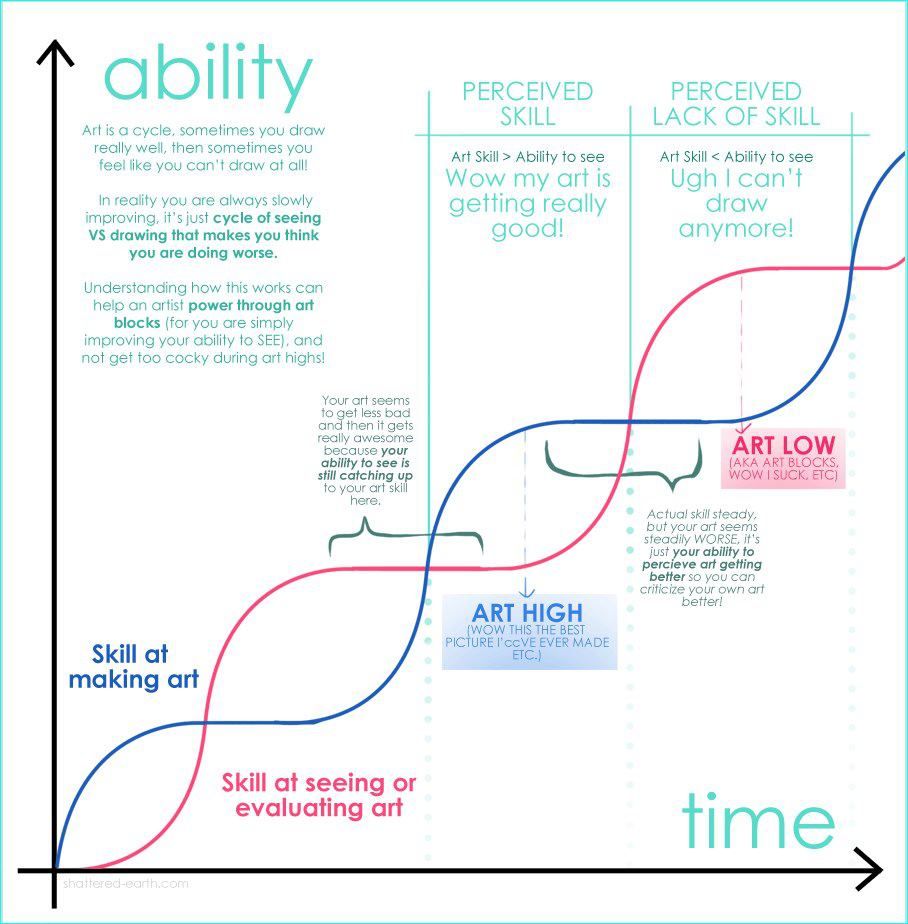
The Artistic Learning Curve The internet can sometimes be productive…usually when you least expect or want it to be. On a recent pointless time-wasting session I accidentally stumbled into two gems of knowledge that I thought profound enough to share: I don’t know a single artist who can’t relate to the learning curve graphic, it’s just so unerringly true. If you know, you know. For the life of me I can’t track down the original URL in order to give proper credit, but I found it too accurate and insightful to withhold. This other graphic is from an unrelated source, but perfectly appropriate, and a great context through which to interpret the previous one:
Read →
December 21, 2012
Notes & Advice 4: Clear Seeing and Accurate Drawing
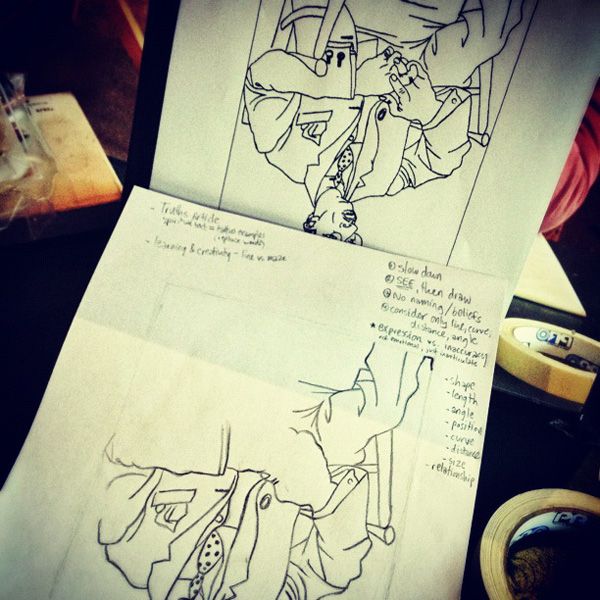
Earlier this month I attended a 3 day intensive drawing course hosted by an artistic mentor of mine, Edward Povey. This course started from the absolute foundations of drawing–clear and simple seeing, lines, and shapes–and progressed by the third day, after a brief foray into tone and value, into a full-fledged classical still life. While I had taken a similar foundations of drawing course around a decade ago (wow, that sounds like I’m old…and an “adult.” Wierd.) in art college, I wanted to revisit these incredibly important disciplines in order to sharpen up my artistic skills. Edward taught the course with a combination of classic drawing exercises, and insightful personal anecdotes about the nature of seeing. His philosophy emphasized the faithful recording what we see, in the tradition of “the humble craftsman.” Exercise: reproduce the Picasso drawing upside down, without regard to subject matter. Simply observe line, shapes, and proportions. Many of the exercises were taken directly from the popular book by Betty Edwards Drawing On the Right Side of The Brain ( which I personally have never read, but can now vouch for after this experience), such as the Vase/Face exercise which you can see here. One of the most demonstrative exercises consisted of trying to reproduce a complex line shape in exact precision while simultaneously counting aloud, from 50 to zero. I won’t spoil the amusing results of conducting such an experiment by describing them in detail here, in case you should decide to try it yourself. But let’s just say, it puts the two sides of your brain into a major state of conflict. All drawing consists of, is working with one’s own mind. The most poignant lesson that was reinforced for me over the 3 days was the emphasis on clear, simple seeing. Much like a meditation practice, this places emphasis on simply seeing the physical reality before us in all of its detailed truthfulness, without the confusion nor illusion of belief. For example, our mind knows and believes that a human arm may be approximately 3 feet long, but when seen in sharp perspective, the appearance of the arm becomes far shorter (aka ‘foreshortened’), and we must account for this when drawing it on a 2-dimensional surface. This cognitive dissonance between our belief about the arm and the reality of how it appears on our retinas (and therefore must appear on the paper) is the reason why drawing complex forms with complete accuracy is incredibly difficult. Therefore an artist must learn to disconnect from certain areas of thought in their brain, and tune into the unembellished truth of reality, breaking it down into simple criteria of line, shape, and negative space (the areas or shapes between/around featured subject matter). Extreme precision in this task can be achieved with measuring techniques and devices, but it is not impossible to do so completely with one’s own eyes and mind. It takes patience, practice, and a willingness to let go of our ego and all of its beliefs. Words of wisdom. As a painter of realism, this practice is indispensable for me. All of my aesthetic illusions must be grounded in, must stem from, the fundamental truth of how objects or spaces look in reality, or else their believability will be compromised. Not to mention, the strength of all representational art in the first place, regardless of chosen specialty or chosen illusions, lies in the accurate reproduction of 3D forms onto a 2D surface. Subjecting oneself to the rigors of classical drawing training is the most efficient way to stay sharp, no matter how advanced or practiced one is. It’s the same concept as strengthening muscles by going to the gym. After a while, certain drawing exercises are likely to make less of an impact as they become more familiar/easier, and just as with physical strength, the artist can increase the artistic challenge by adding time limits or more complex subject matter. I strongly encourage all artists to revisit the simple disciplines of drawing as a way to “work out” their skills of observation and their representational accuracy. Here’s my completed drawing from the final day of the class: Form & Emptiness, Graphite on Paper, 2012, 12in x 9in Form & Emptiness (detail). The title of this piece is a reference to the Buddhist teachings on the nature of reality, as represented by the dominating dark form in the center of the composition bearing my reflection, and of course by the empty glass and mug. This title is also a reference to the similarities between the clear seeing techniques used for drawing, and the awareness cultivated in meditation practice.
Read →
October 13, 2012
Notes & Advice 3: Photographs vs. Paintings
The appropriate and effective use of reference material–notably, where and how to deviate from it to actually heighten illusions, ironically–has been an ongoing commentary of mine on this blog, being mentioned in a few past entries. I consider this issue a central concern for any painter working in the realist genre, or who depends upon “fool the eye” illusions for the success of their images. I’m always trying to increase my knowledge and refine my skill in this area, as well as find succinct and poignant ways of explaining it to others. Austin-based, British-born artist Edward Povey, whom I’ve recieved valuable instruction and mentoring from over the past few years, had an interesting take on this concept in a recent email newsletter: Artists and photographers are really both image-makers. The camera truly sees, and the artists could learn from its honesty. The photographers could learn from the artists’ profound sense of composition, knowledge of color, tonal value constructions, and expressiveness–relying less on the cleverness of the modern camera. I believe that the wisest artists will be intimately aware of this dichotomy, and will strategically use the best of each world for the overall success of their images.
Read →
September 19, 2012
Notes & Advice 2: Darker/Grayer
There are certain tricks or techniques an artist can use to enhance the illusion of 3d form in their work. Picking any number of these tools from the mental drawer can drastically improve a painting, and they prove especially helpful in realism when an artist develops the intuition to deviate from the reference where necessary, in order to make a more successful painting (as opposed to a more successful reproduction). One such tool is knowing where and how to reduce the chroma (or intensity) of an object’s local color as it recedes into shadow. In the words of classically-trained figurative painter Shane Wolf: It’s crucial that the lighter value mixture be slightly higher chroma than the next darker mixture as this is how form works in nature. “Lighter brighter; darker grayer” is an old academic saying that explains that if an object is in light, it’s brighter; as it turns away from light into halftone, it gets darker and grayer. (Wolf, Shane. “Alla Prima, Three Hour Sketch.” The Artist’s Magazine. November 2012: 38-39) We all know that shadows make colors darker, but what we often forget–myself included–is that to complete the illusion in a painting, it may also be necessary to dial back the brightness/chroma/intensity of local colors to avoid shadows that compete for depth-space with foreground surfaces or objects, to the detriment of the overall image.
Read →
September 3, 2012
Notes & Advice 1: Stepping Back
Words of wisdom, from the astoundingly skilled, 26-year-old, San Fransisco-based painter Hsin-Yao Tseng: “It’s important to squint your eyes while studying your subject and to stand back from your painting frequently. Squinting simplifies the details so you can see the big shapes and value patterns of the subject. Also, you get a sense of the lost-and-found edges. Standing back from your painting lets you evaluate the unity of the piece. Seeing the unity prevents you from overworking detailed areas or making unnecessary brushstrokes.” (Seidner, Rosemary Barrett. “Born To Paint.” The Artist’s Magazine. October 2012: 44-51) Great advice for perfectionist, detail-obsessed realism painters. Although aware of this advice long before reading Tseng’s feature this week, I too often forget to practice it. It was a timely reminder, as I was just about to put the finishing touches on a new experimental painting. The more experimental or unfamiliar the territory that an artist is navigating, the more important it is to have his trusty fundamentals and basic skills by his side, like a compass, should he suddenly realize how lost he is. So, Inspired by this painter wise beyond his years, I spent a recent afternoon in the studio focusing on this teaching. Being mindful to step back and gaze loosely at the overall image every 30 minutes or so, I found it a very refreshing practice. Note to self: do more of this.
Read →